


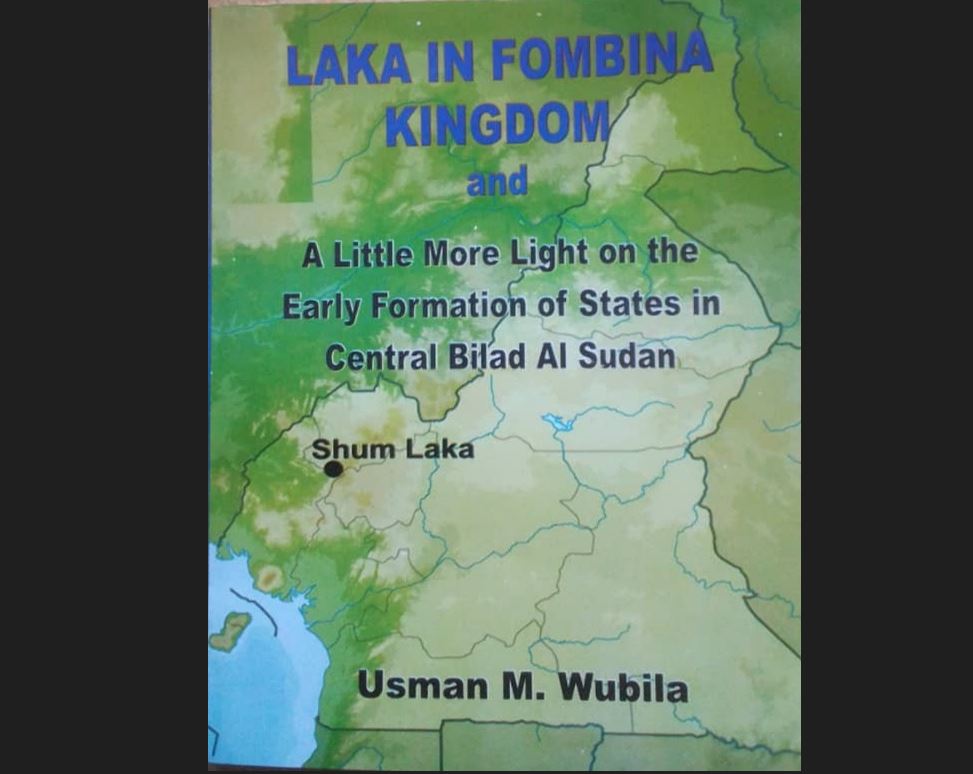
Title of Book: LAKA IN FOMBINA And a little more light on the early formation of States in Central Bilad Al- sudan
Reviewer: Usman M. Wubila
CHAPTER ONE
LAKA IN EARLY TIMES
The historical evolution of the Laka people started in Mereo which is located between the Nile and Atbara Rivers after the Egyptian Army attacked Napata, which belongs to the Kushite dynasty. The fall of Mereo witnessed the migration of people in 3way traffic: South east, Southwest and Central zone.
The last King of Mereo was King SAYZAMA, and had two sons; Djila and Mbairo with Mbagidje as their elder sister.
Later Djila became BAGIRMI and Mbairo became MAGUMI. After the death of the King, Mbairo left Mereo to the Central Bilad Al-Sudan (S-W Journey), while Djila (Bagirmi) left to the south east of Central Bilad Al-Sudan, and Mbagidje and her descendants moved to central Bilad Al-sudan and eventually settled in Central Africa, Southwest Cameroun and Southern Africa.
Djila and Mbairo began to expand into various clan units: Sara Bagirmi had thirty dialects, and occupied South west and Central Bilad Al-Sudan. Magumi (mbairo) migrated to the Southwest of Bilad Al-Sudan and had Sao, Bulala and Kotoko which produced the KANURI, Gamargu and Kibaku language. The connection between the Kanuri and the descendants of Bagirmi, Mbairo and the northeastern expansion of the descendants of Mbagidje led to the expansion of the Kanuri language and culture into what is called today-the Chadic language.
The Laka people belong to the Bagirmi descendants and their migration is connected to the north southern migrations which was characterized by wars, famine, drought and need for greener pastures.
CHAPTER TWO
*LAKA IN PRECOLONIAL TIMES*
The Laka people in the 15th and 16th Centuary migrated from Vidau and first settled at the fringes of Raimanga, Lakare Chollire and Mbum axis and submitted themselves to the Yillaga Fulbe at Rai and became part of the traditional leadership. They also expanded into Fombina (northern Cameroun) particularly the Ngaundere axis, and the border between Fombina and Chad where they were referred to as Kawu Laka territories under the reign of the Fulbe.
The Laka in the territories of Cameroun, Nigeria, Chad and Central Africa became indigenes’ and citizens with sizeable settlements. So, in the 1st and 2nd World Wars they found themselves participating in the war on either side of the allied forces.
*LAKA IN THE JIHAD*
On the outbreak of the Jihad in Sokoto in 1804 AD and the reception of Islam by Modibbo Adama in Fombina; the Laka people moved to Gurin, the seat of Modibbo Adama to join forces with him. Thus, began the growth and consolidation of Laka people under Modibbo Adama, who referred to them as Pullo Kawu Laka.
*LAKA AND THE JIHAD IN FOMBINA*
The Laka settlement in Gurin began the recruitment of man power for wars and security for Modibbo Adama. When Modibbo Adama left Gurin to Ribadu and to Song between 1830-1838, the bulk of his followers were the laka people.
CHAPTER THREE
*THE CONSOLIDATION OF0 FOMBINA KINGDOM AND FOUNDING OF JIMETA*
The Jihad in Fombina came to a break when Modibbo Adama relocated to Yola along with the Laka warriors and soldiers who acted as the soldiers of Lamido Fombina.
At the critical stage of the Jihad, Sheik Usman Bn Fodio sought for soldiers from Modibbo Adama; so, it was agreed that every six months, Fombina moved One thousand soldiers to Sokoto, and the bulk of this fighting force were the Laka people.
*THE FOUNDING OF JIMETA*
The name Jimeta was derived from a person called Jimta. In the 19th Centuary the European traders made reference to old Jimta to anchor their boats. Jimta had a neigbour called Jabbo, who had a farm near Jimta and goes back to Bagale every evening.
*PATTERN OF SETTLEMENT IN JIMETA*
On the relocation of seat of power from Gurin to Yola, those soldiers who came first set up settlements after their names or bore the names of the conditions they found in that place. Consequently, places like Geriyo (Ger= lake, yo= death), Karewa (karwa= cornstock), Bekaji (Beekaji= sustainable land) and Dobeli (Dobe= top of the town) were named. As the town gradually expanded, the Adamawa emirate council granted it a village head status with the title of Ajiya Jimeta. The first village head was a Laka man followed by his son. The Laka people were also given appointments as Wambai Bakari, Sarkin Bindiga Salman, Sarkin Dogari, Samu ga Allah by Lamido Fombina.
*THE ECONOMIC IMPERATIVES IN THE EXPANSION OF JIMETA*
In 1903, the European traders recognized Yola as a great potential area for economic and administrative control based on agreements reached at Berlin conference in 1885AD. The river bank of Jimeta became attractive for local and external businesses. The port of Jimeta had links with Garoua in Cameroun and other places which led to its expansion and the hinter land.
In 1883 Lamido Sanda granted permission to the National African Company to establish factory in Yola and this led to regular trade between Yola and Southern part of the country. Thus, the settlements of zango, Limawa, Gwadabawa and Rumnde began with notable tribes like Kakanda, Nupawa, Hausa, Margi, Higgi, Kanuri, and Jukun.
CHAPTER FOUR
*THE SPREAD OF LAKA PEOPLE IN NIGERIA*
With the cessation of Jihad in Fombina in the 19th centuary which coincided with the German, French and British scramble for the territory of Fombina, the Laka people became part of the victims of this colonial war and found themselves with the Allied forces in both the 1st and 2nd World wars.
The demobilization/retirement of troops in the 1st and 2nd World wars and Nigerian civil wars caused the spread of Laka people in places like Kaduna, Kano, Jos, Bauchi, Maiduguri etc. The outbreak of Nigerian Civil war in 1967 led to increase in Laka population in Fombina.
CHAPTER FIVE
*LAKA AND THEIR NEIGBOURS*
The closest neighbors of Laka in the Fombina are the Fulbe, verre and Bata and their links started with Jabbo and the Jihad.
CHAPTER SIX
*LAKA AND PROCESS OF ASSIMILATION*
The mode of assimilation of the Laka people into other tribes has done a great damage to their historical and cultural heritage. The effect on them as a people is inferiority and ethnic disorientation which have passed over to their children and grandchildren.
*UNITY AMONG THE LAKA PEOPLE*
After independence in 1960, the Laka were encouraged by the late Lamido Aliyu Musdafa the then premier ruler of Fombina to unite and nominate one person among themselves to politically represent the area in the Northern Region Assembly in Kaduna but this failed due to lack of unity. In 1986/87 the Laka youths formed the DOLUNA YOUTH CLUB. This later metamorphosed into the Laka Cultural Association in 1992 with the late Dr Lamido Aliyu Musdafa as the 1st Grand patron. On the 30th December, 2018 a bigger association was formed in Yola by the name LAKA CULTURAL ASSOCIATION NIGERIA.
CHAPTER SEVEN
*LAKA AND THE CHALLENGES OF TOMORROW*
The name Laka is what is widely used in the Fombina empire, and the opinion leaders of the over 30 dialect groups adopted a simple name, they could be identified with throughout their areas of settlements. It makes it easier therefore to lump the over 30 dialects as LAKA. For example, the mumuye tribe in Taraba state has 17 dialects and non-understand the other but they are all identified by the common name Mumuye
*About the author*
The author of this book is Usman M. Wubila, he was a veteran Journalist, and presently a book writer and Gude by tribe, and has no connection with the Laka people. The author has written more than six books Including the history of Fulbe, and kingdoms and chiefdoms of people of Mandara, 20 historical documentaries and over 800 analytical commentaries.
The write up on the Laka people has provided a comprehensive and concise information on the historical evolution of the people and the role they played in the Fombina Kingdom. The author has treated the topic deeply by bringing out the different groupings of the Laka dialects and their movements into different parts of Nigeria as a result of massive recruitments to support the Usman Dan Fodio Jihad and recruitments into military, police and paramilitary.
*Weakness of the Book*
Most of the photographs used in the book are hanging not linked to the texts, and the people of Chamba referred to Laka people as KAWU but we don’t know the connection and this book would have helped us to bring out this relationship. I will round up by saying that the book is well written, captivating, and rated excellent
The readership of this book are people of laka extraction, Journalists, researchers, students and scholars.
Book Reviewer: Prof Jackson Ishaku, Department of Geology, Modibbo Adama University, Yola


