


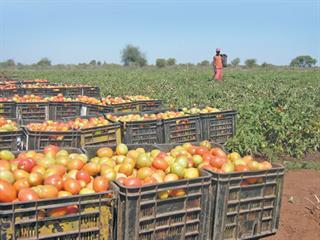
A N250 billion intervention by the Central Bank of Nigeria to address shortfall in local production of fresh tomatoes has compounded the problem of farmers who now have to deal with massive wastage resulting from over production, findings by 21st CENTURY CHRONICLE revealed.
Though production has increased following the injection of the money through the Anchor Borrowers Programme (ABP) for tomato farmers, there is no ready market, particularly from processors to mop up the tomato being produced.
Some producers say that the farmers are not producing enough to enable them produce at full installed capacity, farmers have said the claims are false.
Findings revealed that there has been no commensurate investment in processing, as over 150 companies that hitherto posed as processing companies were only packaging imported concentrates and lack capacity for processing of fresh tomatoes.
Tomato is one of the most consumed vegetables in the country as it is a major ingredient for many staple meals.
Statistics by the Food and Agriculture Organisation (FAO) indicate that Nigeria has the largest area cultivated for fresh tomatoes in Africa with 551,800 hectares and estimates yield per hectare at 3.91 tonnes.
Recent data also shows that annual production of tomatoes in Nigeria is estimated at about 1.701 million tonnes while annual consumption is 2.93 million tonnes, leaving an annual supply shortfall of more than 1.2 million tonnes valued at about 2.5 billion dollars annually which is met through importation and smuggling.
Apart from the low yield per hectare, the quality of the tomatoes is said not to be fit for processing, as available varieties are said to have very low brix content of less than 2.5 against a brix content of between 4.7 and 5.5 required to produce high quality tomato paste. There is also the issue of wastage in the value chain, which reduces the quantity of tomatoes available to meet local demand.
There are an estimated 200,000 tomato farmers in Nigeria, contributing about 10.8% to tomato production in Africa.
However, 45 percent of fresh tomatoes produced in the country is said to be wasting.
Consequently, Nigeria is the 13th largest importer of tomato pastes in the world and the third-largest in Africa.
To address this shortfall, the federal government four years ago, precisely in April 2017, announced a tomato policy, aimed at curbing the loss of an estimated $170 million on importation of tomato concentrate.
According to the government, the policy was which was approved at a meeting of the Federal Executive Council (FEC) was aimed at reducing spending on tomato import and improving local production of fresh tomatoes for local consumption and processing as well as increasing local production of tomato concentrate and reducing post-harvest losses and improving the value chain, boosting production and attracting investment
Data by the federal government as at 2017 showed that Nigeria was importing an average of 150,000 metric tons of tomato concentrate per annum, valued at $170 million, mostly due to inadequate capacity to produce tomato concentrate. Demand for fresh tomato fruits was estimated at about 2.45 million metric tonnes per annum, while the country was producing only about 1.8 million metric tonnes per annum.
The policy which was to restrict the importation of tomato concentrates to the seaports to address the abuse of the ECOWAS Trade Liberalisation Scheme (ETLS), banned the importation of tomatoes preserved otherwise by vinegar or acetic acid; and increased the tariff on tomato concentrate to 50 per cent with an additional levy of $1,500 per metric ton of tomato paste imported.
The expectation was that the policy would lead to the creation of at least 60,000 additional jobs in fresh fruits production and processing.
In 2019, two years after the policy was announced, the then Minister of Agriculture and Natural Resources, Audu Ogbeh, during a tour of the Dangote Tomato Processing Plant in Kadawa, Kano State, assured that the federal government will place a final ban on the importation of tomato paste before the end of that year.
The minister had announced that to encourage massive tomato production post the ban, the federal government had set aside N250 billion through the Central Bank of Nigeria (CBN) and Bank of Agriculture (BOA) to give to tomato farmers as soft loans as part of the Anchor Borrowers Programme (ABP).
“Federal government will continue to encourage Dangote agro-farms and the farmers to grow massive tomatoes in Nigeria and with this kind of outfit, farmers will earn more with better seedlings from the Dangote greenhouse and get better results.
“The farmers will supply to the processor and eventually join tomato breeders in the world. In a short while, Nigeria will simply stop importation and dependence on other sources for tomato supply,” the minister had said.
CBN governor, Godwin Emefiele, who was also on the tour, said the bank supported Dangote greenhouse with N1.3 billion to produce hybrid tomato seedlings to enhance massive local cultivation.
“The greenhouse plant will produce 3 million seedlings which will supply to farmers. With this hybrid tomato seedling, farmers will be able to produce over 70,000 tons per hectare against the 10,000 tons.
“To this end, this output will encourage farmers to increase their production and provide job opportunity. Let me emphasise the federal government ban on those foods and other items we can produce in this country still remain on the banning list,” Emefiele had stated.
No tomato to process – Dangote
However, recently, the management of the Dangote plant, which was inaugurated in March 2016, said it was not producing at full capacity as yield from local farmers was inadequate to support production at the facility.
“We haven’t been able to process enough quantity of tomato to make our operations successful,” managing director of the Dangote Tomato Processing Plant, Abdulkarim Kaita, was quoted as saying.
“At the moment, we are counting losses.”
The plant, one of the largest in Nigeria, currently processes about 300 metric tons of the fruit each day, the highest capacity it has achieved since inception, but barely enough to keep the plant operational, even though it incurs the same overhead costs as if it were operating at its full capacity.
Findings also revealed that to boost local production of tomatoes, the CBN introduced the Commodity Champion Model in the 1st quarter of 2019 to simulate production of tomato and strengthen the end to end linkages from input supplies to the final consumer. The bank adopted the strategy of out grower contractor arrangement in the short to medium term and backward integration in the medium to long term.
According to the bank, its efforts have resulted in the mobilisation and validation of about 140,848 farmers from various tomato farmers associations across 25 states in Nigeria who will be financed through the ABP where they will be linked to processors or financed to produce fresh fruits for direct consumption which constitutes the largest use of tomato in Nigeria.
Executive director of Tomato Agricultural Farmers and Development Association of Nigeria (TAFDAN), Idris Ojoko, said his group was yet to key into the ABP.
He said while his organisation was working to improve local production of the crop to meet market demand, through sensitisation of farmers on improved varieties to grow for higher yield and longer life post-harvest, its members were yet to benefit from any government intervention.
“There’s a line of operation we took as an organisation but we haven’t gotten to that point yet,” he said.
Farmers producing enough tomatoes – Association
The national president, Tomato Growers and Processors Association of Nigeria, Abdullahi Ringim, in an interview dismissed claims in some quarters that farmers were not producing enough fresh tomatoes to meet production capacity of the companies.
“Go to Kadawa, the farmers are there producing. It is not true that the country does not produce enough,” he said.
According to him, Nigeria was sufficient in tomato production but had yet to overcome the problem of wastage, which was as a result of insufficient processing plants, which made it seem like farmers were not growing enough.
“Nigeria is sufficient in tomato production the problem is wastage. The sufficiency came from the double season we operate. We now grow tomatoes twice a year, dry and wet season. The wastage comes as a result of lack of sufficient processing plants.
He explained that before the President Muhammadu Buhari administration, the cluster of tomato packaging companies around Lagos and Sango Otta, about 150 of them were all packaging companies relying on imported paste.
“So they just import the paste or smuggle it in order not to pay duty, access foreign exchange at official rate, rip the country off, produce nothing except just bring in paste, put them in cans and call themselves tomato processors but in fact, they are not tomato processors, they are tomato packaging companies.
“When the association encouraged government to come up with policies, it became a problem for them because they can no longer access the foreign exchange and can no longer import paste without paying duty
“What the government did was to increase the duty from 5 to 50 per cent and introduce tomato levy. Nobody has banned it but because of the cost and because they are used to smuggling it and paying nothing, they decided not to do official importation,” Ringim stated.
He further admitted that members of his association had benefitted from the ABP, which is in its second year, through loans, which had helped to boost their production capacity.
He also dismissed claims by some processors that farmers were not producing enough to meet their installed capacity, saying rather, there was excess fresh produce in supply and farmers had to grapple with wastage.
“Lack of raw materials is not the reason. Ask farmers and they will tell you
“To curb wastage, we have been doing many things, one of which is encouraging backward integration of the packaging companies towards setting p processing plants. Many of them have come back and are setting up processing plants in places like Kaduna, Jigawa, Katsina, Kebbi, Taraba.
“We have also subsidised crating so instead of using baskets which collapse and cause damage to the tomatoes, we have subsidised crates and since the farmers started using them, waste has been reduced from 40 to 15 per cent. In some cases, we have introduced new varieties of tomatoes that have longer life span so instead of the fresh tomato rotting within three days, sometimes it takes 10 to 12 days and that reduces the wastage.”
Efforts to get the CBN’s reaction over a period of two weeks yielded no results despite phone calls, emails and WhatsApp messages to the banks spokesman, Osita Nwanisobi and an official in the media relations unit, Isa Abdulmumin.
While Abdulmumin acknowledged the WhatsApp messages and asked that they be sent to Nwanisobi, the latter never responded. Abdulmumin later said the team was out on official assignment to Katsina State and would respond upon return but never replied subsequent messages.


