


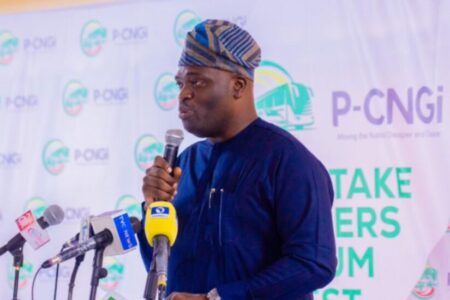
Chief Executive Officer of the Presidential Compressed Natural Gas (CNG) Initiative, Michael Oluwagbemi has disclosed that the sector attracted investments to the tune of over $980m from the private sector in 18 months.
This is just as he said conversions surged from 4,000 to nearly 100,000.
Oluwagbemi made this known during the launch of the Portland Gas Ltd/NASENI CNG Daughter Station, Auto Conversion and Training Centre along the Kubwa Expressway in Abuja.
He stated that the CNG programme was the country’s “fastest-growing energy sector”, fueled by government incentives and private sector participation.
Oluwagbemi said the transition to CNG offered motorists up to 90 per cent savings on fuel costs.
“Many of us move around in big jeeps, but that’s just about 10 to 20 per cent of the population. The majority, low-income earners, women, schoolchildren, and the aged, rely on public transportation, and transportation costs money. CNG is cheaper, cleaner, and part of a global shift away from internal combustion engines,” he explained.
He attributed the rapid expansion of CNG capacity across the country to strategic partnerships and incentives, pointing out that from just five states with CNG dispensing and conversion facilities a year ago, the number had now risen to 20, with more than 315 conversion centres nationwide, with a projection to reach 30 states and the FCT by the end of 2025.
Oluwagbemi cited major private sector investments, including a N720 billion outlay by BUA and Nigerian Bottling Company on CNG trucks and 100 fueling stations.
He also called for the protection of CNG allocated for automobiles from being diverted to gas-fired power plants.
Chief Executive Officer of Portland Gas Ltd, Folajimi Mohammed, described the launched station as a gas hub as it has a combination of everything about gas.
He disclosed that the company has secured approval for the same station to sell liquefied petroleum gas.
Mohammed noted that the cost of conversion has been subsidised by the PCNGI to the extent that it is free of charge for members of the Nigerian Association of Road Transport Owners and National Union of Road Transport Workers, and Bolt drivers.
On his part, Director-General of the Nigerian Agency for Gas Engineering Infrastructure, Khalil Halilu, said the station was strategically located on the Kubwa expressway since it is central to the North and southern parts of the country.
He said in partnership with the PCNGI, NASENI has planned for the queues around CNG stations to disappear in the next two years.
He, however noted that the queues were an indication that Nigerians have really keyed into the CNG initiative.
Meanwhile, the House of Representatives, however, said it would enact legislation to stop the diversion of auto CNG to other uses such as power plants.
Asked whether the lawmakers would do anything to stop the diversion, the Speaker, Tajuddeen Abass, who was represented by Alexander Mascut, said, “The lawmakers will make laws to protect the CNG for auto gas.”


