


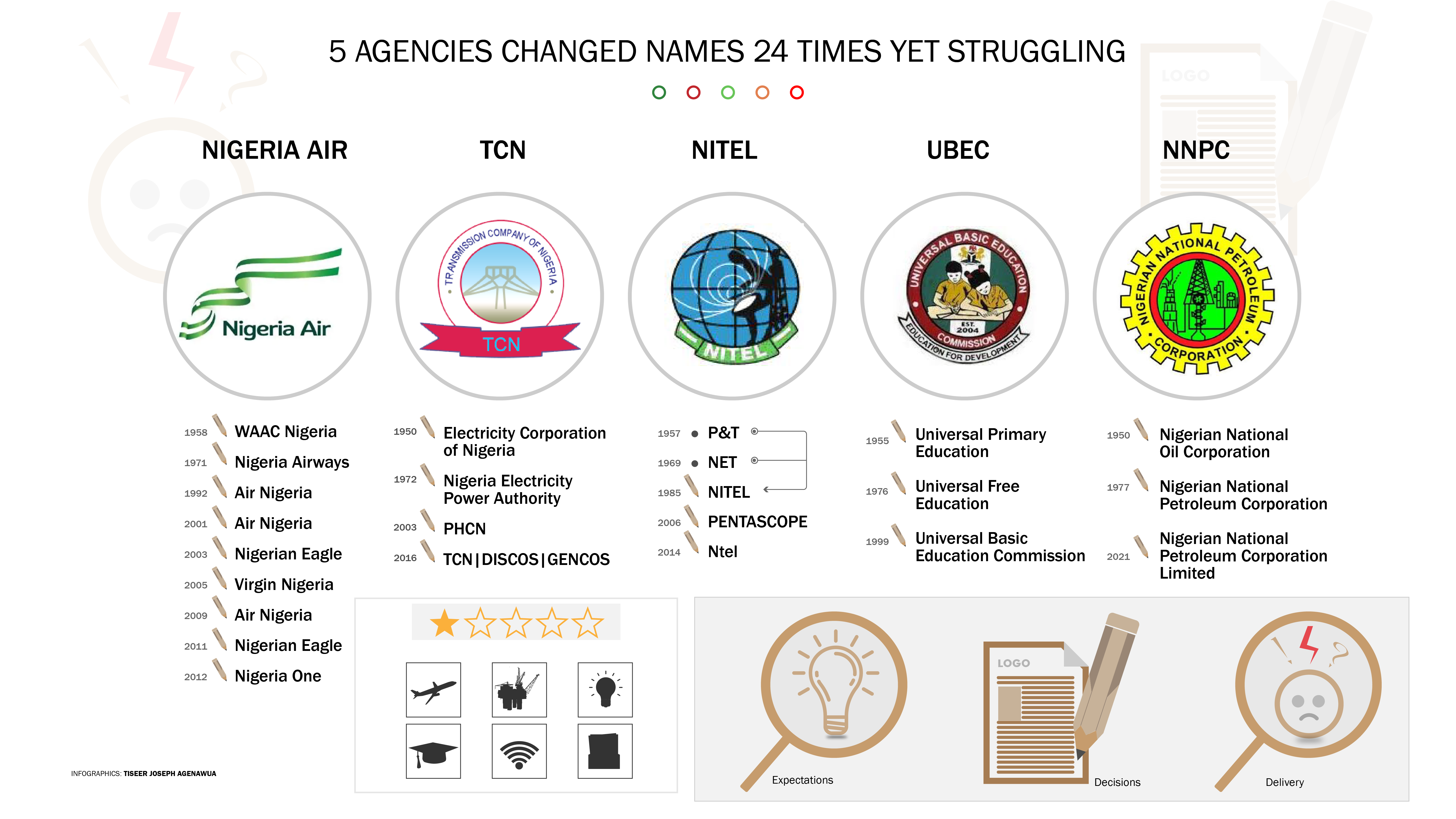
Five key federal government agencies are still struggling to perform their statutory mandates despite rebranding and reorganisation that saw them changing their names at least 24 times, investigations by 21st CENTURY CHRONICLE have revealed.
Among such entities are the Nigeria Airways, Power Holding Company of Nigeria (PHCN), Nigerian Telecommunications Limited (NITEL), Universal Primary Education (UPE) and the Nigerian National Petroleum Corporation (NNPC).
While some of the affected entities, whose services are critical to day-to-day lives of Nigerians, are still struggling to survive, others have fizzled out altogether.
At least two of the federal agencies, notably Nigeria Airways and NITEL, have rebranded and changed names 14 times yet they didn’t not only fail to improve, instead they folded up altogether.
Nigeria Airways
21st CENTURY CHRONICLE’s findings indicate that Nigeria Airways underwent rebranding and name change nine times since the demise of West African Airways Corporation (WAAC) in 1958.
WAAC, which operated from 1946 to 1958, was jointly owned by the governments of British colonies of The Gambia, Gold Coast (Ghana), Nigeria and Sierra Leone.
WAAC operated from Lagos, Nigeria, where it had its headquarters, and was dissolved in 1958 after all the shareholding countries floated their national airlines following independence; leaving Nigeria as the only stakeholder. It continued to operate as WAAC Nigeria until its renaming as Nigeria Airways in 1971.
Nigeria Airways thrived in the early 1980s following the engagement of the KLM team to drive its operations. The organisation had in its fleet aircraft such as Vickers VC10, Airbus A310, Boeing 737/747 and McDonnell Douglas DC-10.
Like most of Nigeria’s public corporations, Nigeria Airways’ fortunes nosedived as a result of corruption, over-staffing and other anomalies. The crises and huge debt overhang crippled its operations and finally brought it to its knees, resulting in its takeover by Air Nigeria, which later became Virgin Nigeria as a joint venture between Nigerian investors and the Virgin Group. It was later rebranded as Nigerian Eagle, the Air Nigeria.
Since then, all effort by the country’s aviation handlers to revive the national airline has failed. The President Muhammadu Buhari administration has made some moves to launch a national carrier project without much success. After the initial suspension of the project in 2018, Hadi Sirika, Minister of Aviation, announced plans to revive the project in 2019.
He had said, “The carrier will be delivered within the life of this administration, this I can assure you.”
He later on said, “It is not forgotten by the government. It will continue, and we are doing everything we can to deliver it.”
In 2021, Sirika again announced that Nigeria’s national airline, Air Nigeria, was set to begin operations in April, 2022.
He noted that Air Nigeria would be run by a company and the Nigerian government would hold a five per cent stake, Nigerian entrepreneurs 46 per cent, and 49 per cent would be reserved for yet-to-be assigned strategic equity partners, including foreign investors.
PHCN
Like aviation, the country’s power sector has continued to struggle and in the process failed to meet the needs of the people despite many rebranding attempts and consequent name changes. From the Electricity Corporation of Nigeria (ECN), it rebranded to National Electric Power Authority (NEPA), then PHCN and now DisCos.
In 1950, the colonial government passed the ECN Ordinance Act 15 in a bid to integrate power and make it effective. The management of ECN changed its name to NEPA shortly after the civil war. It later became a public limited company in 2000, and in 2005 the name changed to PHCN following a power sector reform that took place due to epileptic power supply and other anomalies in the power sector. The unbundling was to allow for a smooth transition from government monopoly to private entities.
However, epileptic power supply continued despite the reform; forcing the federal government to privatise and unbundle PHCN into Generation Companies (GenCos) and Distribution Companies (DISCOs) in 2013. But many years after, the privatisation has failed to bolster the power sector and light up the country. The federal government still pays subsidies to the tune of N120bn monthly to sustain liquidity flow for the privatised sector.
Also, although Nigeria has attracted several funding and technical support from the World Bank and the African Development Bank (AfDB), available data show that energy poverty is still on the rise. The energy crisis, despite the privatisation, has triggered calls by stakeholders for a review of the exercise, which they said was faulty.
NITEL
What later transformed to Nigerian Telecommunications Limited (NITEL) was earlier referred to as the Nigerian Post and Telecommunications (P&T), an agency owned and managed by the federal government. The government later established the Nigerian External Telecommunications (NET) to provide external communication services.
NET and the telecommunications arm of P&T were later merged following the demand for commercialisation of telecommunication services and NITEL was born in 1985, saddled with the responsibility of meeting the telecommunications needs of Nigerians.
Despite the merger, NITEL’s operations remained inefficient, and in 1996, MTEL was established to provide cellular services and sustain the business of NITEL in the deregulated telecom sector. But like most other businesses run by the government, MTEL barely took off before crashing, prompting the federal government to take the privatisation option through the Bureau for Public Enterprises (BPE). Pentascope of Netherlands, an upstart, to the surprise of stakeholders, acquired it despite arrays of reputable firms that bid.
In less than a year, from April 2003, Pentascope squandered the N15bn which it inherited, to record a loss of N19.15bn, with a significant slump in turnover.
In 2006, Transcorp acquired NITEL for $500mn, but after some financial issues, the federal government revoked the acquisition and set up a technical board of management to handle the administration of NITEL and MTEL until the completion of the sales process.
On December 3, 2014, NATCOM emerged as the preferred bidder, with $252.5mn, and sealed the deal with complete payment of the sum in April, 2015, to become the full owners.
However, despite the move, alleged fraud during the process of liquidation and unpaid entitlements of disengaged staff of the organisation dogged its operations.
NITEL is still involved in lingering controversies. There was a rumour of a N41bn fraud involving NITEL in liquidation, and this version of the story pointed fingers at some top banks in the country, causing them to scurry in a bid to clear their names.
NNPC
The NNPC has undergone many transformations under different governments, but crises in the oil sector have continued to persist. Most significantly, in 2016, the federal government approved the creation of seven operational units in the NNPC in an unbundling drive.
In what is referred to as a significant milestone to revamping the oil and gas sector, President Muhammadu Buhari in August, 2021, signed the Petroleum Industry Bill (PIB) into law, almost 20 years after it was first introduced.
The PIB seeks to create the NNPCL, a corporate entity incorporated under the Companies and Allied Matters Act.
In September, 2021, Buhari directed the incorporation of the NNPCL in consonance with Section 53(1) of the Petroleum Industry Act 2021. He also approved the appointment of the board and management of the NNPC Limited, with effect from the date of incorporation of the company.
On January 7, he inaugurated the board with a charge to them to ensure strict compliance with corporate governance principles that place a premium on doing business with the highest ethical standards, integrity and transparency.
UBE
Universal Basic Education (UBE) started as Universal Primary Education (UPE) in 1955 and became Universal Free Education (UFE) 1976.
UBE emerged from a reform effort aimed at increasing access and ensuring quality basic education in the country.
The UBE Act 2004, which set provisions for basic education consisting of Early Childhood Care and Education (ECCE), Primary Education and Junior Secondary Education, later backed the UBE programme for providing free primary and secondary education for all.
The reform was introduced after several unsuccessful attempts at improving education in the country.
Although stakeholders agree that there is a level of improvement as regards enrollment, the same cannot be said about transition and completion rates, which they claim are still poor.
“As of 2015, Nigeria ranked 103 out of 118 countries in UNESCO’s Education for All (EFA) Development Index, which takes into account universal primary education, adult literacy, quality of education and gender parity,” a report indicated.


